
4-Corner Model: Decentralized Interoperability
The 4-corner architecture powers global networks like Peppol and DBNAlliance, enabling millions of organizations to exchange invoices through their chosen access points. Discover how this decentralized model delivers maximum flexibility and worldwide connectivity.
The Federated Network Architecture
In the 4-corner model, both sender and receiver each choose their own service provider (access point), while these providers communicate through standardized protocols within a governed network.
The 4-corner model distributes responsibility across four participants: the sender, the sender's access point (Corner 1-2), the receiver's access point (Corner 3), and the receiver (Corner 4). Each organization selects its preferred certified access point provider for connectivity, while the network's governance framework ensures interoperability between all access points regardless of provider.
This federated architecture combines the benefits of centralized standardization with decentralized execution. Organizations maintain flexibility to choose providers based on their specific needs - pricing, features, geographic presence, or ERP integration - while the network guarantees seamless communication with any other participant, regardless of their chosen access point.
Provider Choice
Organizations select their own certified access point based on features, pricing, and integration capabilities without being locked into a single platform.
Global Interoperability
Standardized protocols and governance ensure that any access point can communicate with any other, enabling truly global document exchange across borders and systems.
Network Governance
Central authorities define standards, certify access points, and maintain directory services while leaving operational flexibility to individual providers and participants.
Peppol & DBNAlliance: Global 4-Corner Networks
Two prominent networks demonstrate the power and reach of the 4-corner model across different regions and use cases.
Peppol Network
The Pan-European Public Procurement Online network has evolved into a global standard for electronic procurement and invoicing.
Key Characteristics:
- Mandatory for B2G transactions across EU
- Expanding B2B adoption worldwide
- Strong in Europe, growing in Asia-Pacific
- UBL-based invoice standards
- AS4 secure transport protocol
- OpenPeppol governance structure
DBNAlliance
A business-driven global network focused on commercial document exchange with emphasis on flexibility and business requirements.
Key Characteristics:
- Business-to-business focus
- Format agnostic approach
- Support for various standards (UBL, EDIFACT, proprietary)
- Flexible transport protocols
- Industry-led governance model
- Emphasis on commercial requirements
How 4-Corner Networks Operate
Understanding the document flow through a decentralized network where each party maintains its own service provider connection.
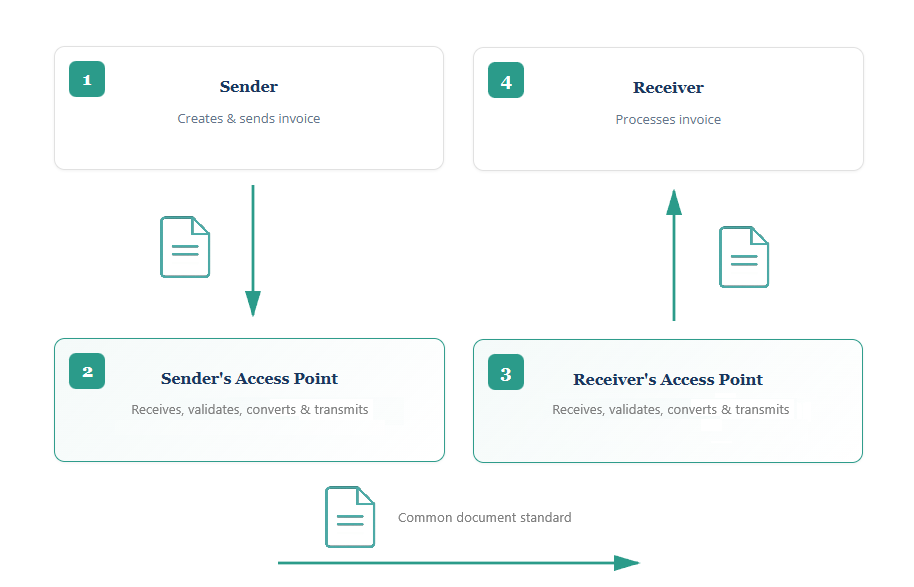
Sender to Access Point
The sender creates an invoice and transmits it to their chosen access point via API, integration, or portal. The access point validates the document structure, enriches metadata with routing information, and prepares it for network transmission using the recipient's network identifier.
Access Point to Access Point
The sender’s service provider receives the invoice from the sender and performs structural and business rule validation to ensure the document complies with applicable technical and regulatory requirements. If necessary, the invoice is converted into a network-compatible standard format.Using the network directory, the sender’s service provider resolves the receiver’s network identifier and determines which service provider acts as the access point for the recipient. The invoice is then securely transmitted to the correct receiving service provider via standardized network protocols. Throughout this process, delivery acknowledgements and integrity checks are exchanged between both service providers to ensure reliable and auditable transmission.
Access Point to Receiver
The receiver’s service provider accepts the incoming invoice and performs validation to confirm document integrity, authenticity, and compliance with applicable network and regulatory rules. If required, the invoice is converted into the receiver’s preferred internal format.The validated invoice is then delivered to the receiver’s endpoint through the agreed integration method, such as API, system integration, or portal access. The service provider records delivery status and provides confirmation back to the sending service provider, completing the controlled and traceable end-to-end exchange.
Why Organizations Choose 4-Corner Networks
The decentralized architecture delivers unique benefits that combine global reach with organizational flexibility.
Truly Global Connectivity
Connect once to reach millions of organizations across 40+ countries. Networks like Peppol enable seamless cross-border invoicing without additional country-specific integrations.
Provider Flexibility
Choose your access point based on your specific needs - pricing, features, regional expertise, or ERP integration. Switch providers without losing network connectivity or partner relationships.
Standardized Yet Flexible
Core standards ensure interoperability while allowing organizations to customize their implementation, workflows, and value-added services through their chosen access point.
Instant Partner Discovery
Network directories enable automatic lookup of any participant's access point. New partners can be added immediately without bilateral setup, negotiations, or technical configurations.
Built-in Compliance
Network governance ensures adherence to regional regulations and international standards. Certified access points maintain compliance obligations automatically as requirements evolve.
Future-Proof Architecture
Networks evolve continuously with new features, document types, and geographic expansion. Organizations benefit from innovation without disruptive migrations or re-implementations.
Organizations Best Suited for 4-Corner Networks
The decentralized model excels for businesses requiring global reach, provider flexibility, or operating in mandated environments.
International Businesses
Companies trading across multiple countries benefit from single-connection global reach. Eliminate the complexity of managing country-specific eInvoicing systems and partner connections.
Government Suppliers
Organizations invoicing public sector entities in Europe where Peppol is mandated. Automatic compliance with B2G requirements across jurisdictions.
Growing Businesses
Companies expanding their supplier or customer base benefit from instant connectivity to new partners without additional integration work.
Enterprises Seeking Control
Large organizations wanting to choose service providers strategically based on features, pricing, and integration capabilities while maintaining network reach.
Multi-System Organizations
Businesses operating diverse ERP environments can select access points with the best integration for each system while maintaining unified network connectivity.
Long-Term Strategists
Organizations planning for future expansion, regulatory changes, or evolving business models appreciate the network's inherent scalability and adaptability.
Joining a 4-Corner Network
Step-by-step guidance for connecting to Peppol, DBNAlliance, or other 4-corner networks through certified access points.
Choose Your Network
Determine which network(s) your trading partners use. Peppol dominates B2G and European markets, while DBNAlliance serves commercial B2B needs. Some access points support multiple networks simultaneously.
Select an Access Point Provider
Compare certified providers based on pricing, features, geographic coverage, ERP integrations, and support services. Request demos and evaluate offerings against your requirements.
Register Your Organization
Your access point provider handles network registration, obtaining your unique network identifier (e.g., Peppol ID), and configuring routing in network directories.
Integrate Systems
Connect your ERP or accounting software to the access point via API, plugin, or other integration methods. Configure document formats, workflows, and validation rules.
Test Connectivity
Exchange test documents with partners or use network testing services. Verify routing, format conversion, acknowledgments, and end-to-end delivery.
Go Live
Start with select partners, monitor transactions, refine configurations, then roll out broadly. Your access point's support team assists throughout deployment.
Ready to Join a Global eInvoicing Network?
Discover how Peppol and DBNAlliance can connect your organization to millions of trading partners worldwide. Compare access point providers, understand implementation requirements, and plan your network integration strategy.


